
Local SEO & Google Maps Experts
How Businesses Actually Rank in Google Maps
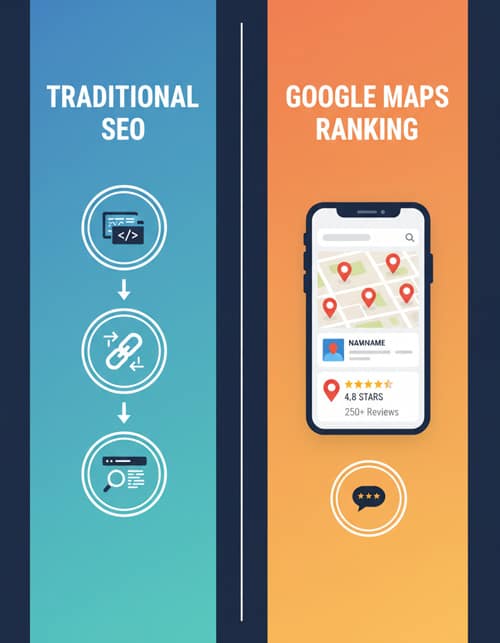
Ranking in Google Maps Is Not Traditional SEO
If you’re trying to rank in Google Maps, the first thing to understand is this:
Google Maps does not rank websites.
It ranks businesses.
That’s why many SEO tactics that work for blog posts or national keywords don’t move the needle locally. Google Maps visibility is based on how clearly Google understands and trusts a business, not how many keywords appear on a page.
This page explains how Google Maps rankings really work and what businesses can do to improve visibility the right way.

Why Google Business Profile Is the Ranking Asset
For Google Maps rankings, your Google Business Profile (GBP) is the primary signal.
Google uses it to understand:
Who your business is
What services you offer
Where you operate
Whether your business is active and trustworthy
Your website exists to support and reinforce what your GBP claims, not to replace it.
How Google Decides Which Businesses Appear in Maps
When someone searches for a service near them, Google evaluates three primary factors.
1. Proximity
How close the business is to the searcher at that moment.
You can’t control proximity, but it does not automatically prevent you from ranking. Google routinely shows businesses outside the immediate area when relevance and trust are strong.
2. Relevance
How clearly Google understands what your business offers.
Relevance is influenced by:
Google Business Profile categories
Listed services
Website pages that support those services
Consistent language across platforms
If Google isn’t sure what you do, it won’t show you, even if your business is legitimate.
3. Authority
Whether Google trusts your business enough to recommend it.
Authority comes from:
Business legitimacy
Consistent information
Local trust signals
Activity and engagement over time
This is where most businesses fall behind, not because they’re bad businesses, but because Google lacks clarity.
What Helps Businesses Rank Higher in Google Maps
Businesses that consistently rank in Maps usually share a few traits:
Clear, accurate GBP categories and services
Website pages aligned to those services
Consistent business information across the web
Activity signals that show the business is real and active
A structure that makes it easy for Google to understand the business
Ranking higher is rarely about doing more.
It’s about removing confusion so Google can confidently recommend the business.
Why Many Businesses Struggle to Rank in Google Maps
Most Google Maps ranking problems come down to one of these issues:
Google isn’t sure which services the business offers
The website doesn’t support GBP relevance
Trust signals are weak or inconsistent
SEO efforts focus on traffic instead of visibility
When Google is uncertain, it defaults to competitors with clearer signals.


How Google Expands Visibility Over Time
Google rarely places a business everywhere at once.
Instead, it:
Tests visibility in smaller areas
Watches engagement and consistency
Gradually expands the business’s presence in Maps
This is why progress often looks gradual at first, then accelerates once trust is established.
Trying to rush this process usually backfires.
Consistency and clarity outperform shortcuts every time.
Ranking in Google Maps Without Breaking the Rules
You do not need:
Fake addresses
Keyword stuffing
Constant category changes
Spam tactics
Google rewards businesses that:
Clearly explain what they do
Stay consistent over time
Build trust naturally
That’s how sustainable Maps visibility is built.


Who Google Maps Rankings Matter Most For
Google Maps visibility is especially important for:
Small businesses competing locally
Service businesses relying on phone calls
Contractors and home service companies
Businesses serving defined service areas
If customers search for what you do near them, Maps rankings often matter more than any other marketing channel.
Not Sure Why You’re Not Ranking Yet?
If your business isn’t ranking in Google Maps the way it should, there’s always a reason, but it’s not always obvious.
Understanding what Google currently sees, and where clarity is missing, is the fastest way to improve visibility without risking setbacks.